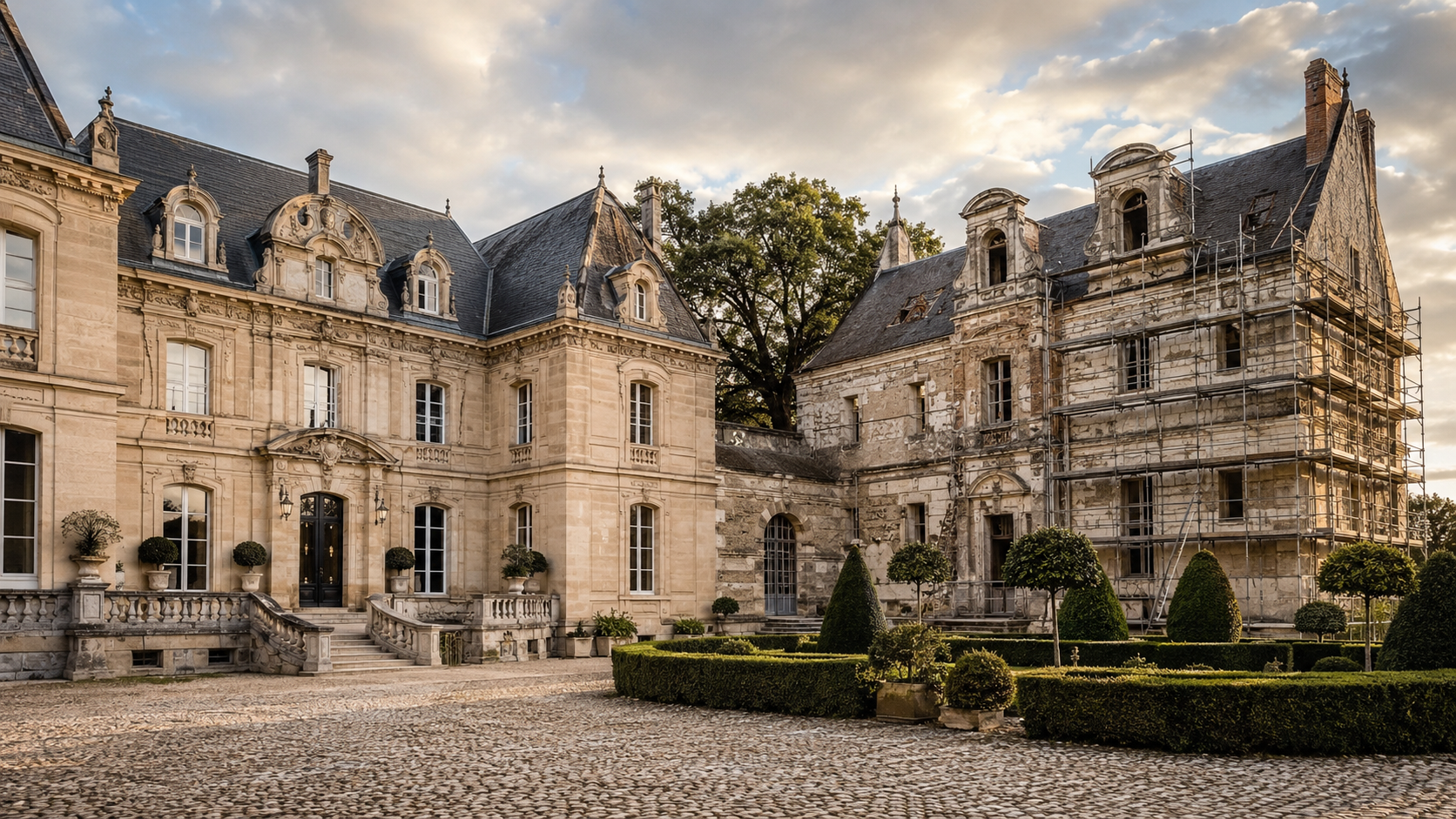
Renovated Château or Restoration Project: What Should You Buy in France?
For many international buyers searching for a château in France, one of the biggest decisions is whether to purchase a fully renovated property or take on a restoration project.
Both options can be extremely rewarding.
But they require very different levels of time, capital and involvement.
Why buy a château to renovate?
A château restoration project can offer an extraordinary opportunity to create something personal.
Buyers may be able to restore historic interiors, redesign kitchens and bathrooms, upgrade heating systems and adapt the property to modern life while preserving its architectural character.
Renovation properties may also have a lower initial asking price.
However, the purchase price should never be confused with the final cost of the project.
Château renovation costs can increase quickly
Historic buildings often reveal unexpected problems once work begins.
What initially appears to be decorative work can uncover issues involving:
roofs;
timber structures;
drainage;
electrical systems;
plumbing;
stonework;
damp;
sanitation;
or structural movement.
This is why a detailed assessment before purchasing is so important.
Renovating a château from overseas
Managing a French renovation project while living abroad can be challenging.
International owners may need to coordinate:
architects;
builders;
electricians;
plumbers;
roofers;
stonemasons;
interior designers;
and specialist heritage contractors.
Communication and project management become particularly important if you cannot visit France regularly.
For some buyers, this is part of the adventure.
For others, it can quickly become overwhelming.
Advantages of buying a renovated château
A renovated château usually offers greater predictability.
The major infrastructure may already have been addressed, allowing the buyer to use the property immediately.
This can be especially valuable if you plan to:
relocate to France;
use the château as a second home;
welcome family and guests;
create a wedding venue;
or operate a hospitality business.
Paying more for a properly restored property can sometimes be more economical than buying cheaply and completing extensive renovation work later.
Preserving historic character
A well-restored château should combine modern comfort with original architecture.
Period fireplaces, parquet flooring, mouldings, staircases and stone façades can coexist beautifully with modern kitchens, bathrooms, heating and technology.
The objective should not be to transform a château into a modern villa.
It should be to make historic architecture comfortable and practical for contemporary living.
Think about your time as well as your budget
One of the most important questions is not financial.
It is how much time you genuinely want to dedicate to the project.
If you love architecture, restoration and project management, renovating a French château can be incredibly satisfying.
If you want to arrive in France and immediately enjoy the property, a renovated château may be a far better match.
Which option offers better value?
There is no universal answer.
Sometimes the best opportunity is a château requiring renovation.
In other situations, a more expensive turnkey property may ultimately save hundreds of thousands of euros and several years of work.
The right decision depends on:
your available budget;
your renovation tolerance;
your timeline;
your intended use;
and how actively involved you want to be.
Searching for a château renovation project in France?
Whether you are looking for a fully restored château or a property with significant renovation potential, I can help identify opportunities that genuinely match your project and your appetite for work.